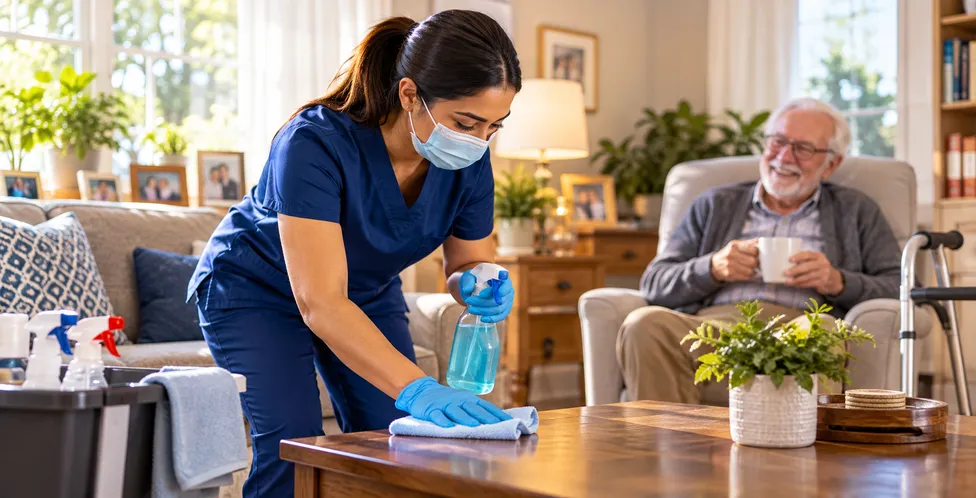







Aging parent at home
Missed meals, forgotten medications, daily tasks becoming harder. A caregiver brings the right support — without taking away independence.
In-home support built around Parkinson's medication times, with help during freezing episodes, at meals, and through the harder hours of the day.
4.9 (250+ Reviews)


98% Client satisfaction
Parkinson’s does not run on a schedule. The same person who buttoned his own shirt at nine may not manage a spoon at one, and by four he is walking the garden as if nothing were wrong. Families learn to live around the good hours and the bad ones — and then to live around the fact that nobody outside the house understands why help is needed at all.
The other thing families learn is the clock. Medication timing in Parkinson’s is not a preference, it is the difference between a functional afternoon and a frozen one, and a dose that slides forty minutes can undo half a day.
Parkinson’s home care from Good Hands Home Health Care is built around exactly these two realities: caregivers who work to the medication schedule, and a care plan that plans for the bad hours instead of pretending every day is the same.


When you need care day and night, we're there!




From aging at home to recovery and long-term conditions, every family's situation is different. We listen first, then build care that fits.
Missed meals, forgotten medications, daily tasks becoming harder. A caregiver brings the right support — without taking away independence.


Healing at home shouldn't feel overwhelming. Hands-on help with mobility, routines, and daily care makes the return smoother for everyone.


Chronic illness or memory changes don't have to mean leaving home. Consistent in-home support keeps comfort, dignity, and connection close.


The care plan is written around the person’s medication schedule and their pattern of good and bad hours, and it is revised as the condition moves.
Medication Reminders on the Clock — doses at the exact times the neurologist set, tracked and recorded rather than remembered.
Mobility & Fall Prevention — safe walking support, help through freezing episodes, transfers, and a home kept clear of trip hazards.
Personal Care — bathing, dressing and grooming, paced to the person’s tempo, with help for buttons, laces and razors when tremor makes them hard.
Meals Adapted to the Condition — cooking with swallowing difficulties and protein-timing considerations in mind, and unhurried help with eating.
Routine & Company — a steady daily structure, encouragement to keep moving, conversation, and escort to appointments and therapy.
Anything clinical — adjusting medication, injections, swallowing assessments — stays with the medical team, and we work alongside them rather than around them.
Good Hands Home Health Care has served Pennsylvania families for more than eight years and holds accreditation from the Accreditation Commission for Health Care, alongside membership in the Pennsylvania Homecare Association.
Every one of our 120-plus caregivers clears a rigorous screening process before entering a client’s home, including a criminal background investigation and a psychological evaluation. Caregivers assigned to Parkinson’s households are selected for experience with the condition — patience with slowness is not a bonus here, it is the job.
Who Benefits from Parkinson’s Home Care
People recently diagnosed who want to stay independent and build the right routine early.
Households where medication timing keeps slipping and the off periods are growing.
People with freezing episodes or falls, where walking alone has become a risk.
Spouses carrying the care alone, often for years, who need reliable relief.
Behind each caregiver stands a team that supervises the care, revises the plan as the condition progresses, and provides backup coverage when a caregiver cannot make a shift. Consistency matters in Parkinson’s, and keeping the same faces on the assignment is treated as part of the care.


Our experienced team handles every detail—from the initial consultation to ongoing support—so your family can focus on what matters most.

You tell us where the condition is, what the medication schedule looks like and where the days are breaking down. We confirm availability.
Our team visits the home, reviews the medication schedule, the pattern of good and bad hours, the fall risks in the house and the support required. The schedule and the quote are settled here.
We select a caregiver experienced with Parkinson’s and suited to the schedule and the personality involved. Consistency matters in this condition, so we keep the team on the assignment small.
Care begins under supervision, with the plan revised as the condition progresses and backup coverage arranged whenever a caregiver is unavailable.







630 Freedom Business Center Dr., 3rd Floor
King of Prussia, PA 19406
Phone Number: 610-285-1095
info@goodhandshomecarellc.com
Mon - Fri: 9AM to 5PM EST
Sat - Sun: On-Call Only
Families across Pennsylvania trust us with the care of the people they love most. Read real reviews from our clients, their families, and the caregivers who make our home health care possible.

Great home care agency. I highly recommend it.


Great service.

Great place to work. I highly recommend it.

Very professional and friendly home care agency. Great place to work. I would recommend this company.
Every member of our team is carefully selected, professionally trained, and committed to providing dependable, respectful care that helps your loved ones feel safe, comfortable, and supported every day.





We're proud to provide trusted in-home care across 14 Pennsylvania counties. Whether you're visiting our office or looking for a home nurse near you, our team is here to help every step of the way.
630 Freedom Business Center Dr., 3rd Floor
King of Prussia, PA 19406
Phone Number: 610-285-1095
info@goodhandshomecarellc.com
Mon - Fri: 9AM to 5PM EST
Sat - Sun: On-Call Only
A Parkinson’s caregiver provides non-medical support built around the condition: medication reminders at the exact times the neurologist set, safe walking and help through freezing episodes, bathing and dressing paced to the person’s tempo, meals adapted to swallowing difficulties, fall prevention around the home, and steady daily routine and company. Clinical tasks stay with the medical team.
Parkinson’s medications work by keeping dopamine levels steady, and their effect wears off on a predictable cycle. A dose taken late can leave the person in an “off” period — stiff, slow and sometimes unable to move well — until the next dose takes hold. Keeping doses on the neurologist’s schedule is one of the most valuable things day-to-day care can do.
Freezing is a sudden, temporary inability to start or continue walking — often at doorways, turns or in tight spaces — and it is a major cause of falls. Caregivers help by staying close during walking, keeping paths wide and clear, allowing time rather than rushing, and using simple cueing techniques such as rhythm or stepping targets that many people find help them restart.
Yes, and starting early often means starting small: a few hours a week for the tasks tremor makes slow, help building an exercise and medication routine, and a relationship with a caregiver before the need grows. Regular routine and staying active are widely encouraged in Parkinson’s care, and support that keeps both going earns its place early.
Medicare does not pay for ongoing non-medical home care. It may cover home health services ordered by a physician — such as physical, occupational or speech therapy visits — which are clinical and separate. Daily support is usually funded privately, through long-term care insurance, VA benefits, or Pennsylvania’s Medicaid Waiver and Community HealthChoices programs where the person qualifies.
Caregivers prepare food consistent with the guidance the household has been given — including modified textures where a speech-language pathologist has recommended them — and provide unhurried help with eating. Assessment of swallowing and any change to those recommendations stays with the clinical team.
The care plan moves with the condition. Households commonly start with a few daytime hours and add more as mobility, medication complexity or night-time needs grow. Where Parkinson’s leads to significant cognitive change or round-the-clock needs, care can extend to full coverage without starting the process again.
Yes. Spouses carry most Parkinson’s care, often for years, and scheduled relief is one of the most common reasons families call. A caregiver can cover the same block each week, an overnight, or a longer stretch for travel or the spouse’s own health — and the same caregiver returns wherever the schedule allows.



Parkinson’s home care is non-medical, in-home support built around the specific demands of the condition: medication doses kept on the neurologist’s schedule, safe movement and fall prevention, personal care paced to the person’s tempo, meals adapted to swallowing changes, and a steady routine through days that vary hour by hour. It ranges from a few hours a week to continuous coverage, and the plan moves as the condition does.
What separates it from general senior care is the rhythm. Parkinson’s produces good hours and bad hours in the same day, and care that works is scheduled and paced around that pattern rather than around a fixed idea of what the person can do.
Most Parkinson’s medications work by keeping dopamine levels steady, and their effect wears off on a cycle. When a dose lands on time, the next stretch of the day is workable. When it slides, the person can drop into an “off” period — stiff, slow, sometimes barely able to move — and stay there until the next dose takes hold.
This is why medication reminders in Parkinson’s care are not the gentle nudge they are elsewhere. The caregiver works to the exact times the neurologist set, tracks that each dose was actually taken, and schedules meals around doses where the medical team has advised it, since protein can affect how some Parkinson’s medications absorb. The record of what was taken and when also gives the neurologist real data at the next appointment, instead of a best guess.
Changing doses or times is never the caregiver’s call. That stays with the medical team, and the caregiver’s job is to make the prescribed schedule actually happen.
Falls are the injury risk that hangs over Parkinson’s households, and freezing of gait is a large part of why. Freezing is a sudden inability to start or continue walking — feet planted as if glued — and it tends to strike at doorways, at turns, in tight spaces and under time pressure.
Caregivers manage the risk from two directions. The home side: paths kept wide and clear, rugs and cords dealt with, lighting improved, the routes to the bathroom and kitchen made as simple as possible. The human side: staying close during walking, never rushing, and using the cueing techniques many people with Parkinson’s find help them restart — a rhythm, a count, a target to step toward.
Balance work, walking practice and exercise programs set by a physical therapist get reinforced between sessions, because regular movement is one of the most widely encouraged elements of living with Parkinson’s, and it is the first thing to slip when every trip across the room feels like a project.
Parkinson’s moves slowly for most people, and the plan should move with it rather than being rebuilt in a crisis.
| Stage | What Daily Life Looks Like | What Care Usually Covers |
|---|---|---|
| Early | Tremor and slowness on one side, daily tasks take longer, independence largely intact | A few hours a week: the tasks tremor makes slow, building the medication and exercise routine, household support |
| Middle | Both sides affected, balance declining, off periods appearing, dressing and bathing getting difficult | Daily visits: personal care, medication on the clock, walking support, meals, fall prevention, relief for the spouse |
| Advanced | Significant mobility loss, swallowing and speech changes, possible cognitive change, help needed through the night | Extended or continuous coverage: full personal care, transfers, adapted meals, overnight support |
Households commonly start in one column and move right over years. Because the plan is reviewed as circumstances change, adding hours does not mean starting the process again — and where the condition eventually needs round-the-clock support, 24-hour home care continues from the same plan.
Families are usually prepared for the tremor and blindsided by everything else. Soft speech that makes phone calls exhausting. Handwriting that shrinks until the shopping list is illegible. A face that shows less expression, which strangers misread as coldness. Sleep broken by vivid dreams and stiffness. Constipation, low blood pressure on standing, and a fatigue that has nothing to do with effort.
Day-to-day care absorbs a lot of this quietly. The caregiver makes the calls the person no longer wants to make, writes the lists, allows double time for everything without commenting on it, and treats a bad hour as a bad hour rather than a decline. For the person, the difference between being helped and being managed usually comes down to exactly this.
Apathy and low mood are also part of the condition for many people, and they are worth naming to the medical team rather than treating as character. A caregiver who sees the person daily is often the first to notice the change worth reporting.
Parkinson’s care inside a marriage runs for years, and it intensifies so gradually that the carrying spouse rarely notices the point at which their own life stopped. The average week of a Parkinson’s spouse in the middle stages involves being timekeeper, cook, safety rail, chauffeur and secretary — and sleeping with one ear open.
Scheduled relief is not a luxury on top of the care plan. It is part of it. A caregiver covering the same block each week gives the spouse a predictable window that is actually theirs; an overnight gives them sleep; a longer booking covers travel or their own surgery. For planned breaks, respite care is built for exactly this, and the same caregiver returns wherever the schedule allows.
Care is billed by the hour. What moves the rate is the level of support required, how many hours a week are booked, and whether coverage falls on weekdays, weekends, evenings or overnight. Parkinson’s households often grow their hours gradually over years, which makes the flexible hourly structure a better fit than fixed packages.
The hourly rate covers the caregiver’s time, the supervision behind them, the written care plan and backup coverage. There is no separate charge for the assessment visit or for building the plan.
Families in Pennsylvania usually pay through one of the following:
Medicare does not pay for ongoing non-medical home care. It may cover home health services ordered by a physician — physical, occupational or speech therapy visits — which are clinical, time-limited and separate from the daily support described on this page.
To get an exact figure, schedule the free in-home assessment. You will leave that visit with a written scope and a rate, with no obligation attached.
Parkinson’s care plans usually combine several of these over the course of the condition.